Showing posts with label Major League Baseball. Show all posts

Tuesday, October 06, 2015

Why Cardinals Fans Should Root For The Cubs Wednesday

This post first appeared on Mark's Cubs Worship Pulpit, an official MLB Blog


Well, it’s finally happened. The Cubs are in the playoffs. And while I still think MLB Playoffs Rootability Index this year.
2016 will be the Season Of A Dream for the Cubs, one never knows what the boys have up their sleeves. After all, they did win 97 games, have one of the most exciting rookies in years in Kris Bryant, the big bat of Anthony Rizzo, and the lights-out pitching of Jake Arrieta. That’s why ESPN put the Northsiders at the top of their
The Cubs play the Pittsburgh Pirates Wednesday night in the NL Wild Card Game to see who will go on to face the St. Louis Cardinals in the NLDS. As a rule, Cardinals fans aren’t very fond of the Cubs or anything having to do with the Cubs. And that means many of them will automatically root for the Cubs to lose in any game, especially one that could advance them to face the Cards. But the smart Cardinals fan should rethink that notion, because Baseball’s Best Fans would benefit in a big way from a Cubs/Cards NLDS.
  • Cardinals fans LOVE stats, so look at these 2015 season matchups:
    • Cardinals vs. Pirates 10-9
    • Cardinals vs. Cubs 11-8
  • Sure, it’s a one game swing, but any advantage should be good for the Redbirds, and since it’s a game of inches, that one extra win from the Cubs may make all the difference in the world.
  • It’s only a five game series, so Cardinals fans only have to drive to Chicago, which is a lot closer than Pittsburgh, to try and buy tickets to the two games in the Windy City and end up watching the action in a Wrigeyville bar. (For what it’s worth, I highly recommend The Cubby Bear, home of many of my brain cells over the years and right across the street from Wrigley Field)
  • More Cubs fans than Pirates fans will make the trip to Busch Stadium for the same reason. Sure, some might get into the game, but most of them will be crammed into Ballpark Village drinking beer that’s just as expensive as inside the ballpark and maybe even listening to Joe Buck provide between inning commentary, which is punishment for any Cubs fan.
  • And let’s be real here, St. Louis needs all the tourist money it can get these days. Think of the dough those giddy Cubs fans will drop while they celebrate having their team in the playoffs for the first time since 2008? Tony’s and Mike Shannon’s are gonna be packed, PACKED I tell ya!
  • Heck, its only a FIVE GAME SERIES. Win 2 at home, knock off the Cubs on the road, and then rest up for whatever suckers the Cardinals face next. Bang, zoom. You get to beat your biggest rivals and then sit at home and watch Frank Cusumano carry on about how easy it’ll be to slaughter whoever dares to face the Mighty Cardinals.
  • If anyone is going to ruin the Cubs’ chances of getting to the World Series, shouldn’t it be the Cardinals? Beating Pittsburgh would be nice and all that, but what satisfaction do you get from that? Mocking bottles of Heinz Ketchup? Cardinals fans deserve better than that.
cards_cubs(1)So you see, Cardinals fans, there are plenty of reasons for you to toss aside your long standing hatred of the Cubs, at least for one night. Think of it as short-term pain for long-term gain. Don’t you want to see the Cubs humiliated by The Cardinal Way? Wouldn’t you like to take a nice four hour ride to follow your heroes and see them advance to the NLCS by winning game 3 or 4 at what the late Steve Goodman called an “ivy-covered burial ground“? Well, that can’t happen if the Pirates prevail Wednesday night. Face it, Cardinal Nation, if the Cubs win Wednesday night, so do you. If they lose, it’s just another Red October without all the juicy hatred and rivalry the Cubs stir up in you.
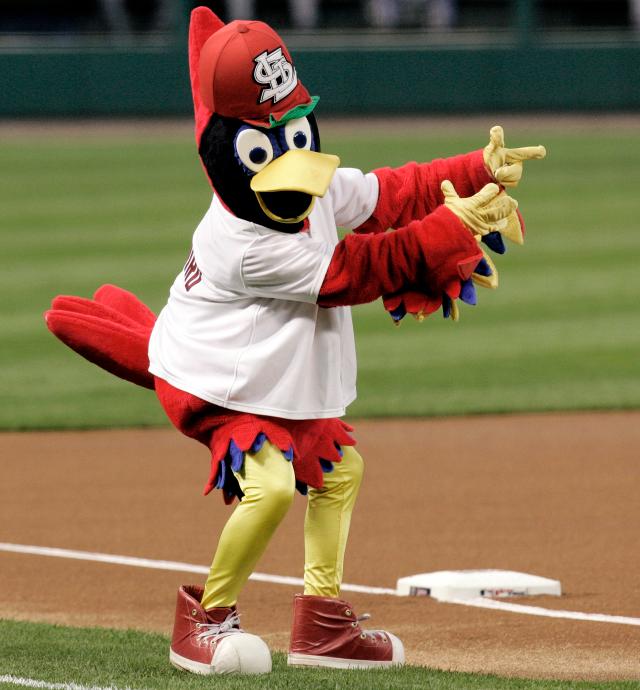
I bet Fredbird would even be celebrating a Cards/Cubs NLDS series.
fredbird_j5lide2v_wxpmhfmh

Thursday, May 17, 2012

Chicago vs. Chicago. No, Not NATO, Cubs vs. Sox

I'd normally post this on my Official Major League Baseball Blog, but they don't like video embeds over there, so you can enjoy it here.

On the eve of the Cubs/White Sox series this weekend, New Era Caps and Funny Or Die have released the second video in their "Chicago vs. Chicago" series.  In case you missed the first, here they both are for your viewing pleasure. 


And yes, I'd pull out my own tooth to see the Cubs in the World Series.
Enhanced by Zemanta

Friday, July 08, 2011

Death at the Ballpark: The national pastime's shocking death toll. - By Jon Mooallem - Slate Magazine

On Thursday night, a 39-year-old Texas Rangers fan fell to his death from the outfield bleachers after catching a ball tossed his way by outfielder Josh Hamilton. As Jon Mooallem explained in 2009, there's a long history of tragic deaths at American ballparks. The original piece is reprinted below.

Josh Hamilton of the Texas Rangers (click to expand)

I caught a foul ball once. Sort of. It was in the fall of 1998, at Coors Field in Denver, and I was sitting on the third-base side. The ball blazed over my head, then thudded into a woman's left breast a few rows back. A second later, it shot out from under my seat and rolled into my foot, as though it had just finished a trip through the interior of a miniature golf course obstacle. I reached down and picked it up.

I did the whole ecstatic exercise. I held the ball over my head. I turned right, then left, showing off my trophy. Then I caught sight of the woman behind me. A small crowd of loved ones and wincing strangers had huddled around her. I decided the only gentlemanly thing to do was to toss her the ball. But I had to wait a moment, until she straightened up and stopped moaning.

Related in Slate
Timothy Noah found that other forms of leisure can be dangerous as well. David Roth described how even fantasy baseball can be damaging, if only to one's mental health. Josh Levin explained why baseball itself is, by definition, perpetually dying.

The typical baseball game sends 35 to 40 of these projectiles into the stands, some of them rocketing in at upward of 100 miles per hour. But it was a nice night for baseball in Denver, and so, for five or six more innings, even as the foul balls kept being popped, poked, lined, and ripped into the seats around me, I just sat there, blanketed by all the warm feelings our national pastime inspires. Even then, it never occurred to me that, as the introduction to a strange recent book puts it, "baseball is sometimes lethal."

Death at the Ballpark: A Comprehensive Study of Game-Related Fatalities, 1862-2007 is an impeccably sourced compendium of the men, women, and children who have died or been fatally injured while playing, officiating, or watching baseball in the United States. Its authors, Robert M. Gorman and David Weeks, two librarians and baseball historians at Winthrop University in South Carolina, have spent the last eight years scouring local-newspaper archives (sample search terms: "baseball and death" and "baseball and killed") for examples, in some cases going so far as to track down death certificates to confirm their results.

Advertisement

Given the fetish for statistics in baseball, it was probably inevitable that someone would get around to recording this, too: the number of people baseball has rendered incapable of generating more statistics. Gorman told me he was drawn into this morbid line of research after stumbling across the death of a minor leaguer named Herb Gorman. ("He had my last name. It kind of piqued my interest.") Neither Gorman nor Weeks had ever really thought about baseball as a deadly activity before, and, Gorman told me, after publishing two preliminary articles—one on beaning fatalities and another on fan fatalities at major league stadiums—"we thought maybe we'd exhausted whatever was out there." They were very wrong. They chronicled 850 baseball deaths in Death at the Ballpark, spanning professional, amateur, Little League, and even backyard pickup games. And though the book purports to be comprehensive, readers have already tipped them off to about 50 incidents they missed.

The authors say their aim was to "raise awareness" about baseball's many dangers, but there aren't any recommendations for making the sport safer here, no real signs of impassioned outrage, and no warnings to suburban parents about aluminum bats. Death at the Ballpark is fundamentally a reference book—a list carefully organized into categories like "Thrown Ball Fatalities, Amateur Fatalities—Position Players" and "Thrown Ball Fatalities, Amateur Fatalities—Baserunners." Often, however, the authors pause for a half-page to narrate a death in noirlike detail. The opening paragraph of one entry ominously begins, "Patrick J. McTavey, 38, worked home plate during a heated semipro championship game on Long Island, NY, on September 26, 1927," and ends: "It was the last call he ever made."

It's weirdly moving, if not exactly consoling, to learn just how many of baseball's casualties made the play before expiring. There's the amateur shortstop who, in 1902, caught a bad hop in the throat and used his last moments to throw out the runner at first. The third baseman in an Indiana league who, in 1909, tagged out the runner plowing headfirst into his gut, then succumbed to the resulting internal injuries three days later. There's just something about baseball that inspires a kind of heroic resolve. John McSherry, the major league umpire who collapsed at Cincinnati's Riverfront Stadium in 1996, had actually postponed treatment for the heart condition that felled him so he could call the game.* It was Opening Day.

All the old romantic baseball tropes turn up again and again in Death at the Ballpark. But the effect is haunting, since here each is mercilessly punctuated with a death. There's the aging minor leaguer, battling his way back to the majors after a couple of stints in the show—except that Millard Fillmore "Dixie" Howell, who played in the White Sox farm system in the '50s, never gets called up again and dies of a heart attack instead. A few incidents are such ruthless perversions of our shared baseball idylls that it's as if Roman Polanski had recut Field of Dreams. One July night in a backyard in Houston in 1950, a 7-year-old boy asks if he can throw his dad one more pitch before heading inside. The father says OK. The son pitches. Then the father swings and connects, inadvertently "striking his son over the heart." The son dies before they can make it to the hospital.

There's no underestimating baseball's versatile capacity for killing us. Late Commissioner A. Bartlett Giamatti famously wrote that baseball "is designed to break your heart," and the statement takes on new meaning reading Death at the Ballpark, particularly Gorman and Weeks' section on commotio cordis, or concussions of the heart. A commotio cordis can be brought about only by getting struck at a particular place in the chest at the exact moment between heartbeats. And yet it manages to dispatch several pages' worth of victims.

Fatal fastballs to the head, meanwhile, aren't nearly as common as you'd expect. In the past 150 years, only one fan at a major league baseball game has been killed by a foul ball—a 14-year-old in Los Angeles named Alan Fish. The liner that fractured Fish's skull came off the bat of Dodger pinch-hitting specialist Manny Mota, whose own teenage nephew would be killed 14 years later while playing shortstop in New York—a coincidence Gorman and Weeks don't stop to note. Mota's nephew, a high-schooler, was struck by lightning as he stood in the field, five minutes after the umpire announced he was going to call the game at the end of the inning.

Lightning is another improbably frequent killer (though perhaps it's less improbable when you consider that baseball is played in summer, typically on flat fields surrounded by metal bleachers and fences). During a 1949 amateur game in Florida, the third baseman, shortstop, and second baseman were all killed by a single lightning bolt, which struck the backstop, then shot around the infield as though completing a double play.

The grim catalog rolls on. A semipro pitcher in Cincinnati is "struck simultaneously on the head by both a thrown and batted ball while warming up before a game." Pickup games played on improvised fields lead to outfielders chasing balls into the paths of cars, buses, trains, and, in one case, a hearse. At Ebbets Field in 1950, a man slumps over in his seat, shot through the back of his head by—it only becomes clear after days of police work—a teenager who was fooling around with a rifle on the roof of his apartment building several hundred yards away and with no clear line of sight.

Then there's a story Gorman and Weeks had both heard versions of but always assumed was apocryphal until they ran down a local newspaper account confirming it: In Morristown, Ohio, in 1902, one man asks another if he can borrow his penknife so he can sharpen the pencil he's using to keep score. The second man hands his penknife to the guy seated between them, named Stanton Walker, and asks Walker to pass it on. At that exact moment, a foul ball whaps Walker on the wrist, and he stabs himself.

Still, in the end, you could choose to see something slightly uplifting about the sheer volume of these freak and incomprehensible accidents. Take it as an indicator of just how much time Americans have spent on and around baseball fields over the last century and a half—of what baseball means to us. We've managed to die on the diamond in so many crazy ways only because it's one of the places we've done the most living. We've all been shagging flies in that minefield together.

Gorman told me that, while working on the book, he himself got smacked square in the forehead by a foul ball at a Triple A Game in Charlotte, N.C. "And my wife, she got hit in an odd way!" he added, almost as an afterthought. Then he launched into another story, about another game, on another night.

Correction, May 26, 2009: This piece originally and incorrectly stated that John McSherry collapsed while umpiring a game in St. Louis. It was in Cincinnati. (Return to the corrected sentence.)

Like Slate on Facebook. Follow us on Twitter.

Jon Mooallem, a contributing writer to the New York Times Magazine, lives in San Francisco.
Photo by Rick Yeatts/Getty Images.

My Twitter Account

Scary facts about our National Pastime, and it doesn't even count how many fans the Chicago Cubs have killed (or at least shortened their lives) by playing the way they do. Thanks to Slate.com for sharing.

Posted via email from Mark Edwards 3.0

Thursday, May 19, 2011

I Am Convinced The World Will End Saturday

This entry is reposted from my Official Major League Baseball Blog, Mark's Cub Worship Pulpit

So there's this preacher who says the world will end on May 21, which is this Saturday. But when I go directly to his web site, he says Saturday is Judgement Day and the world will end on October 21, which is my middle son's birthday. So I may not have to buy him some advanced electronic gadget if we're all vaporized, which isn't all bad. And I still get to celebrate MY birthday on Roctober 18th, not that I'll have too much time to enjoy the underwear and energy drinks that my family will buy me for my big day. But the problem is this. The Cubs are returning to Fenway Park to play the Red Sox this weekend. I was supposed to go to those games, but just can't get away to see my heroes at the second best ballpark in baseball. And the tickets I thought I was getting, uh, never came through, which is another story that has me quite aggravated. Think about it, the Cubs return to play in Fenway for the first time since 1918 on the weekend that some think the world will end. They've moved the game to Prime Time, so we can all tune in to see the carnage (Judgement Day, not the Cubs getting beat like eggs for an angel food cake) with the special touch of Joe Buck's play by play. What could be more perfect? Could the douchebag Commissioner Of Baseball be in cahoots with someone more omnipotent than even HIM to have arranged this cruel punishment?

"Yeah, so here's the deal. We get two of the most storied teams in baseball together for the first time in forever in Boston then we have you send down bolts of lightening or frogs or whatever it is you send down to let people know its Judgement Day and give the world a warning by wiping out all those insane Red Sox and Cubs fans. And I'll even throw in Joe Buck, I know you probably want him gone five months early. Hey, it's the least I can do for you letting me not get fired over that whole drug scandal thing."

Will it happen? Doubtful. But if it does, I won't be anywhere near as depressed about missing the games. And I get to save a couple hundred bucks on my kid's birthday gift.

Posted via email from Mark Edwards 3.0

Thursday, March 31, 2011

NOW THAT'S What I'm Talking About!

This is on mlb.com, the Official Site Of Major League Baseball right now.  Please note the standings in the National League Central.


 Yes, that would be the Cubs in FIRST and Cardinals in LAST.
Thank you to The Commissioner Of Baseball.